Read the fade before you sit down
Guard numbers are not millimetres until you name the clipper. Taper Line is a bulletin, not a barbershop: we read the ladder so you walk in knowing your own numbers — not a word of it is for sale.

- No booking
- No checkout
- No account
- Reads in millimetres
The ladder
Pick a clipper, pick a guard, pick a lever. Get the length in millimetres — and the point on the head where that number belongs. The whole argument of this bulletin lives in one panel.
Figures are blade-exposure estimates for new, well-oiled combs. Worn teeth, bent clips and a heavy hand all add or take a fraction. Read it as a starting point, not a promise.
- Crown
- Parietal ridge
- Temple
- Ear line
- Nape
- 0
- 0.5
- 1
- 2
- 3
- 4
A #1 leaves about 3 mm. The number is a slot in the set; the millimetre is the cut. Always read a guard number next to its length.
- Top length — left long
- Parietal — the turn
- Upper blend
- Temple / side
- Low guard
- Skin edge
| Maker | #2 guard | Reads as |
|---|---|---|
| Maker A (USA) | #2 | 6.0 mm |
| Maker B | #2 | 6.0 mm |
| Maker C (inch) | #2 | 6.4 mm |
| Maker D (EU) | #2 | 6.0 mm |
One number, four lengths. Name the maker and the millimetre stops being a guess.
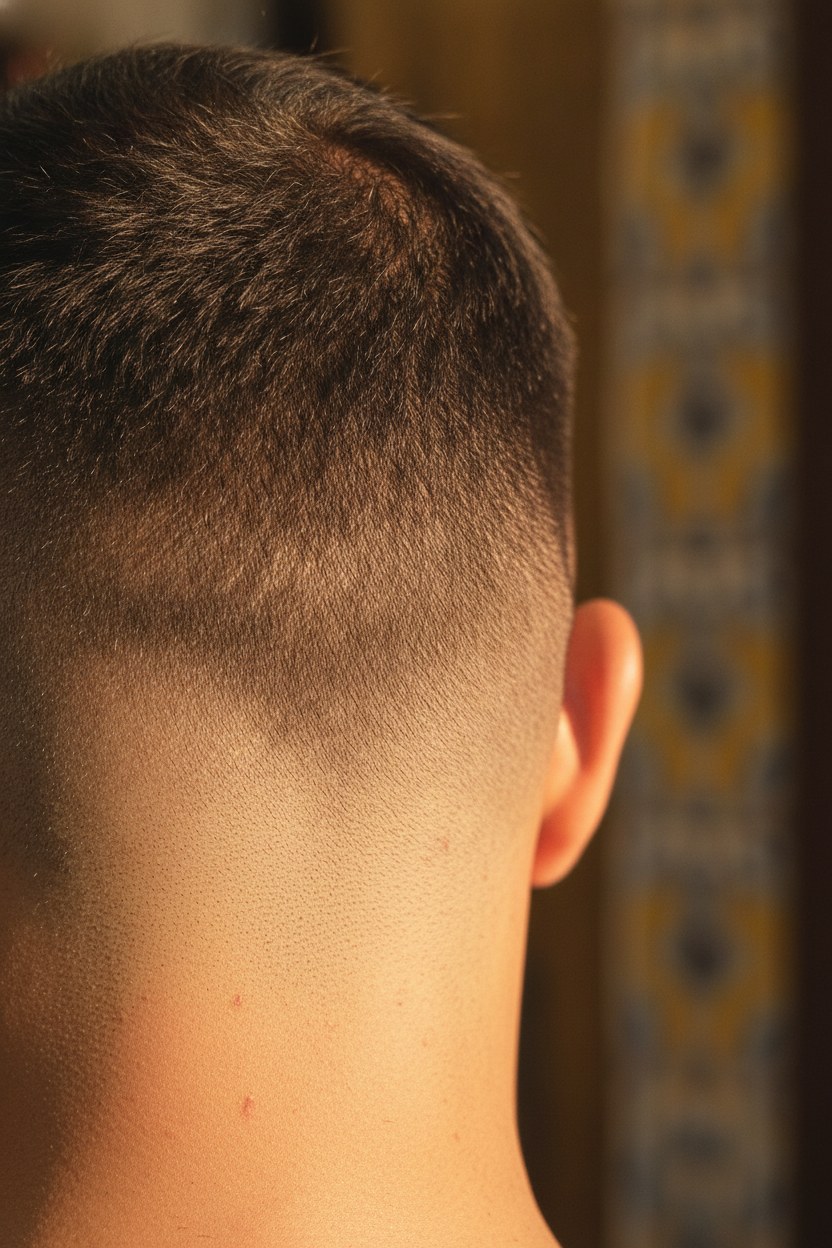
A fade is a decision, not a number
The word “taper” names a transition, not a length. Before any guard touches a head, someone has decided where the short becomes the long. Name that line and the numbers follow.
- SkinStarts at the napeBare at the neck, climbing within a finger's width. Sharpest look, shortest memory.
- LowStarts just above the earConservative, grows out evenly. The default most barbers reach for.
- MidStarts at the templeThe halfway line most people picture when they say “a fade”.
- HighStarts at the parietal ridgeDramatic contrast up top. Demands regular upkeep to stay clean.
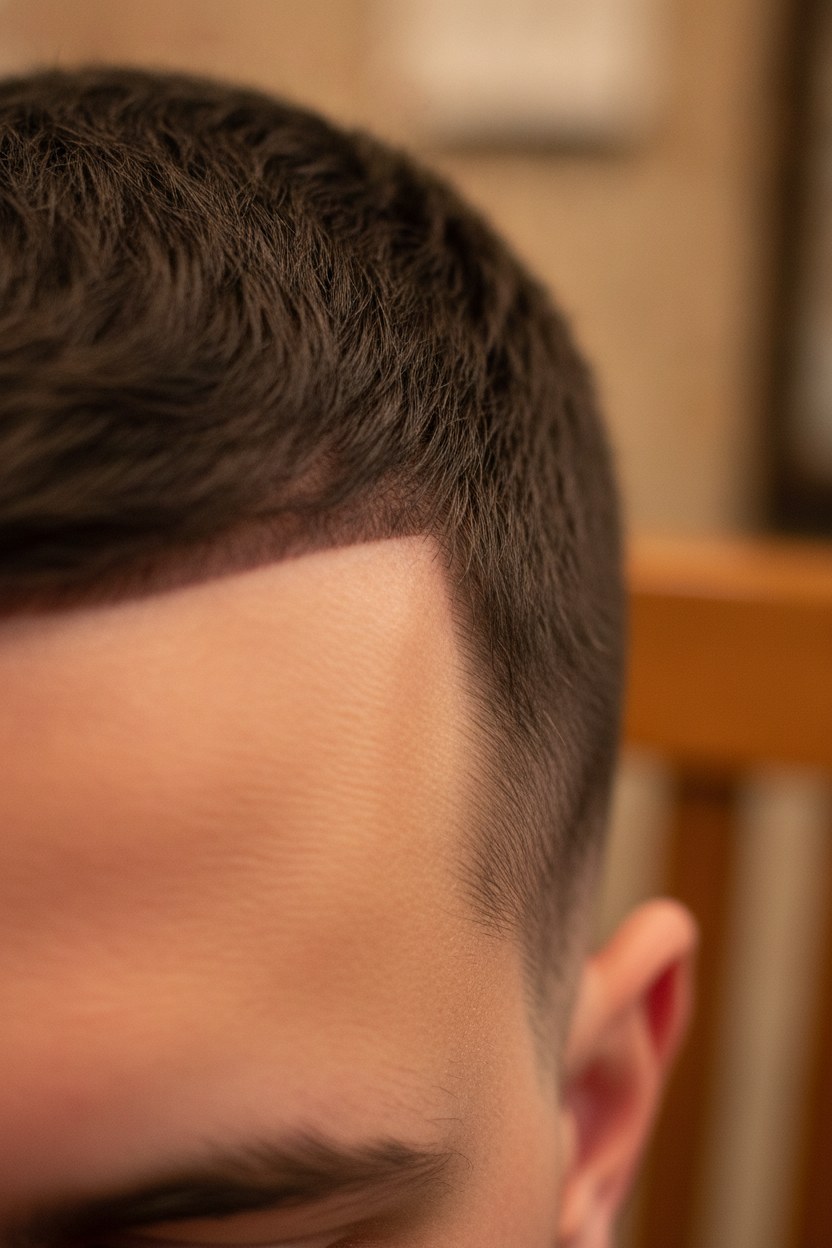
Where a line-up belongs
A line-up sits where your hair naturally wants to stop — not where a straight edge says it could. Pushed too far back for a cleaner look today, it reads as a receding line in a month, and no amount of edging walks it forward again.
The honest line follows your corners, not a ruler. An edge should flatter the head you have in six weeks, not only the one in the mirror right now.
needs a line every two weeksSkin reads ~3 weeks
A skin fade looks bare for roughly three weeks, then the stubble shadow returns and softens the contrast. If you need it clean for a date on the calendar, count backwards — three to five days out, not the morning of.
- W1
- W2
- W3
- W4
Wet hair sits shorter
Wet hair lies flat and looks a full guard shorter than it will dry — the way it does under a hot towel at the sink. Judge a cut dry, or you will chase a length that was never there and leave a notch too tight.
judge it dryHair loss is a doctor's question
A fade can flatter a thinning crown, but it cannot treat one. Shedding, sudden patches or a receding line are questions for a dermatologist — not for a clipper guard. We read lengths, not scalps.
see a dermatologistWhere the numbers get settled
The bulletin isn't written at a desk. Every figure here comes off a steel bench in Kadıköy, where combs are gauged one at a time against a rule. Nothing on this page is a service — there is no booking, no checkout and no account. It is a record of what each guard actually leaves behind.
One comb, one rule, written down
A guard goes under the gauge, the length is read on dry hair, and the number is noted next to the maker and the lever position. When a maker's number drifts from the millimetre it claims, that drift gets printed too. No figure reaches the ladder until it has been gauged twice.
- 1 combmeasured against a steel rule, not a memory
- 25 minto gauge a full set of guards for one machine
- gauged twicebefore any number is printed
“A number you cannot measure is a number you are guessing. We would rather print the drift than pretend the guard is the length.”
Caferağa, KadıköyFrom “a two on the sides” to a number you own
Five steps, no mystery — the way the bulletin reads a cut so you never again hand a barber a guess.
-
01
Name the clipper
Start with the make and model you (or your barber) use. Without the maker, a guard number is only half a fact.
before anything -
02
Measure the guards
Every comb goes under the gauge. We note where the maker's number drifts from the millimetre it claims — this is where most confusion starts.
0–15 min -
03
Map it to the head
Fade height against the hairline, the lever sweep for the skin edge, and where a line-up should honestly sit. Each length lands on the ladder as you read.
15–45 min -
04
Write the card
A pocket card in plain millimetres: guard, lever, where the taper begins. Hand it across any chair and you are speaking the barber's own language.
end of reading -
05
Read it again in two weeks
Once the cut has grown in, look again. Check the lengths held up and adjust the card if your hair argued back. After that, the numbers are yours.
two weeks on
Recently added
- 0118 Nov 2026
Added a European table. European numbering skips steps the US makers keep — a #9 lands near 25 mm with nothing between #6 and #9. Now live in the ladder.
- 0202 Nov 2026
Rewrote the half-guard note. Reader mail convinced us the 1 mm rule of thumb was too clean. Half-guards drift most between makers; the tool now says so out loud.
- 0311 Oct 2026
Lever sweep added to the output. Every guard now shows its closed-to-open range, because the most common question we get is “why isn't it short enough?”
Frequently asked
7 answers · no sales pitch
Why isn't a #2 the same length everywhere?
Because guard numbering is a maker's convention, not a standard. One maker's #2 is close to 6 mm; another lands nearer 6.4 mm because it works in inch fractions. The number tells you the position in that maker's set — the millimetre tells you the cut. Name the clipper and the length stops being a guess.
What does the taper lever actually change?
The lever moves the cutting blade relative to the comb. Closed (up) leaves the longest cut for that blade; open (down) exposes more teeth and cuts closer, shaving roughly half a millimetre to a millimetre off the guard's nominal length. That sweep is why the tool shows a range, not a single figure.
How long does a skin fade stay sharp?
About three weeks before the bare look softens into shadow and the contrast fades. If you need it crisp for a specific day, cut three to five days ahead rather than the morning of — freshly bladed skin can read as too stark in photos.
Is Taper Line a barbershop?
No. Taper Line is a bulletin — a reference on reading the fade. There is no chair service, no booking, no checkout and no account on this site. We describe guard lengths so any barber can deliver yours — we don't pick up the clipper for you.
Should I judge my cut wet or dry?
Dry, always. Wet hair lies flat and can look a whole guard shorter than it will once it dries and lifts. Barbers check and refine on dry hair for exactly this reason; if you judge the length at the sink you will almost always ask for it tighter than you really want.
Can a fade fix thinning hair?
It can flatter it — a well-placed fade draws the eye and balances a thinning crown — but it cannot treat it. Shedding, sudden patches or a receding hairline are medical questions for a dermatologist. We read guard lengths, not scalps, and we will always say so.
Do the figures account for worn blades?
No — they assume new, clean, well-oiled combs. Worn teeth, bent clips, a build-up of hair in the comb and simple hand pressure all nudge the real length. Treat every number as a starting point you confirm on dry hair, not a measurement fixed to the tenth of a millimetre.
Learn your numbers once
Open the ladder above, or write to the bench about a clipper table that reads wrong. Either way, you leave the guessing behind — and nothing here asks for your card.
A bulletin, not a chair